
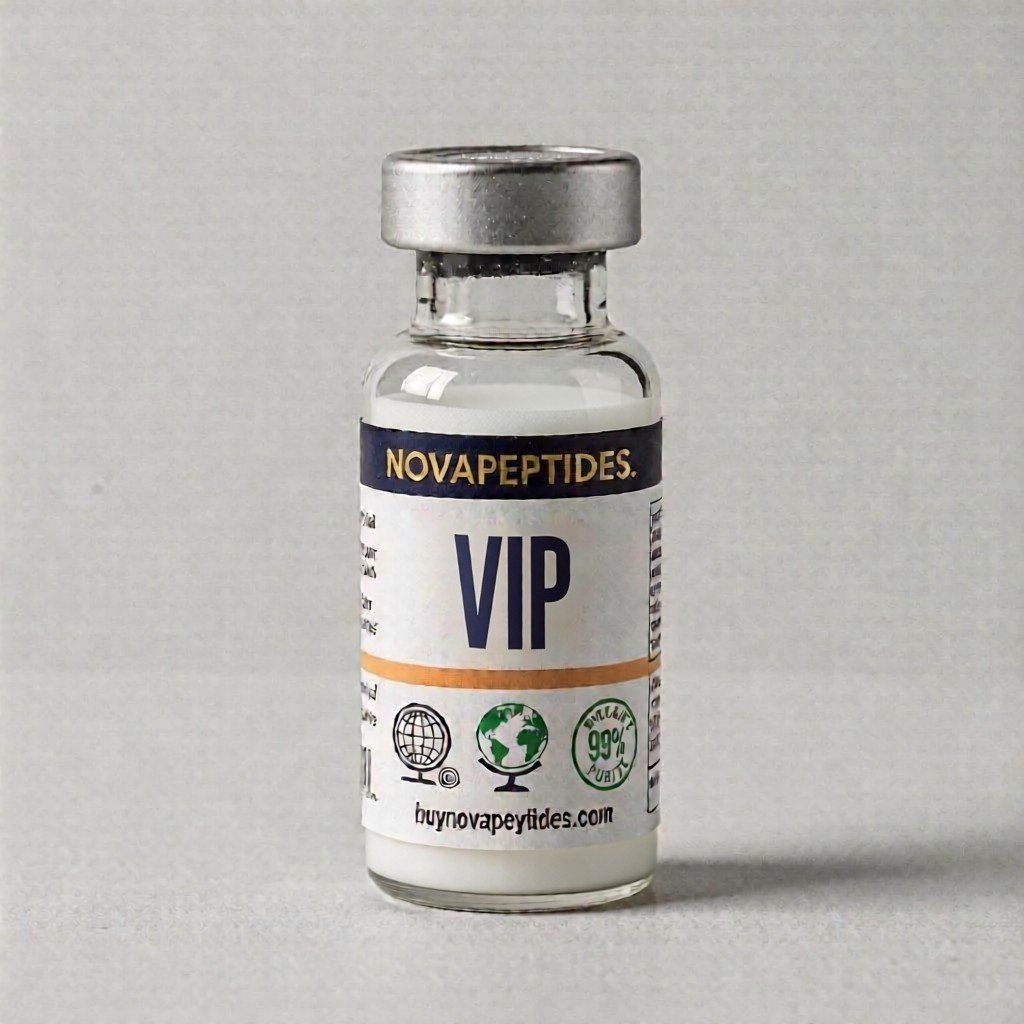
VIP: The Vasoactive Intestinal Peptide for Multi-System Research
$140.00
VIP (Vasoactive Intestinal Peptide) is a 28-amino-acid neuropeptide and gut hormone discovered in 1970 by Said and Mutt, belonging to the glucagon/secretin superfamily of peptide hormones. Produced in the central and peripheral nervous systems, gastrointestinal tract, and immune cells, VIP functions as a pleiotropic signaling molecule with diverse physiological roles. The peptide exerts its effects through VPAC1 and VPAC2 receptors (class B GPCRs shared with PACAP), activating adenylyl cyclase and increasing intracellular cAMP. VIP has been extensively studied for its vasodilatory and bronchodilatory properties, immunomodulatory effects (inhibiting pro-inflammatory cytokines TNF-α, IL-6, IL-12 while upregulating anti-inflammatory IL-10), neuroprotective actions, and regulation of circadian rhythms in the suprachiasmatic nucleus. Research applications span inflammatory diseases, pulmonary hypertension, neurodegeneration, and circadian rhythm disorders.
VIP: The Pleiotropic Neuropeptide Bridging Multiple Physiological Systems
VIP stands as one of the most versatile signaling molecules in mammalian physiology—a single 28-amino-acid peptide that simultaneously regulates vascular tone, immune responses, neural function, and circadian rhythms. Discovered over five decades ago in the porcine intestine, this deceptively simple molecule has revealed itself to be a master coordinator of bodily homeostasis, acting as both a neurotransmitter in the brain and a hormone in the periphery. For researchers investigating the integration of neural, immune, and endocrine systems, VIP offers an unparalleled window into how complex organisms coordinate disparate physiological functions through shared molecular language.
Discovery and Structural Characterization
The story of VIP begins in 1970 when Swedish scientists Sami Said and Viktor Mutt isolated a novel peptide from porcine duodenal extracts that produced profound vasodilation when administered to experimental animals. They named it Vasoactive Intestinal Peptide—VIP—reflecting its site of discovery and primary pharmacological activity.
Structural analysis revealed a 28-amino-acid peptide with the sequence:
His-Ser-Asp-Ala-Val-Phe-Thr-Asp-Asn-Tyr-Thr-Arg-Leu-Arg-Lys-Gln-Met-Ala-Val-Lys-Lys-Tyr-Leu-Asn-Ser-Ile-Leu-Asn
Research published in Wikipedia and NIH/PMC confirms that VIP “belongs to a glucagon/secretin superfamily” of peptide hormones, sharing structural homology with PACAP, secretin, glucagon, GIP, and GHRH. This family membership explains its mechanism of action through class B G protein-coupled receptors.
Receptor Mechanism and Signal Transduction
VIP exerts its diverse effects through three distinct G protein-coupled receptors, as documented in NIH/PMC:
VPAC1 Receptor: Widely distributed throughout the body, particularly in lung, liver, and immune tissues. VPAC1 binds VIP and PACAP with equal affinity and couples to Gs proteins to stimulate adenylyl cyclase.
VPAC2 Receptor: More selectively expressed, with high levels in the suprachiasmatic nucleus (circadian clock), pancreas, and certain immune cells. Also binds VIP and PACAP equivalently.
PAC1 Receptor: Preferentially binds PACAP over VIP; primarily neuronal distribution.
The canonical signaling pathway involves:
- Gs protein activation upon VIP binding
- Stimulation of adenylyl cyclase
- Conversion of ATP to cyclic AMP (cAMP)
- Activation of protein kinase A (PKA)
- Phosphorylation of downstream targets including CREB
This cAMP/PKA cascade mediates most of VIP‘s physiological effects, from smooth muscle relaxation to gene transcription regulation.
Immunomodulatory and Anti-Inflammatory Functions
One of the most extensively studied aspects of VIP is its profound immunomodulatory activity. Unlike traditional anti-inflammatory agents that target single pathways, VIP coordinately regulates multiple immune cell types and cytokine networks.
Research published in NIH/PMC and Meto demonstrates that “VIP binding to VPAC1 on macrophages and monocytes inhibits TNF-α, IL-6, and IL-12 production while simultaneously upregulating the anti-inflammatory cytokine IL-10.”
Key immunomodulatory effects include:
- Macrophage Inhibition: Reduced pro-inflammatory cytokine production and M1 polarization
- Dendritic Cell Modulation: Promotion of tolerogenic DC phenotype
- T-Cell Polarization: Shift toward Th2 and regulatory T-cell responses
- Microglial Regulation: Suppression of neuroinflammation
- Mast Cell Stabilization: Reduced degranulation and histamine release
This broad immunosuppressive profile has generated interest in VIP for conditions ranging from autoimmune diseases to septic shock.
Neuroprotection and Circadian Rhythm Regulation
In the central nervous system, VIP serves dual functions as both a neurotransmitter and a neuroprotective agent. The peptide is particularly abundant in the suprachiasmatic nucleus (SCN)—the master circadian clock—where it functions as a critical output signal coordinating daily physiological rhythms.
Research in Loti Labs highlights that “VIP participates simultaneously in circadian timekeeping, immune homeostasis, and neuroprotection,” raising questions about functional coordination between these systems.
Neuroprotective mechanisms include:
- Anti-Apoptotic Signaling: Activation of survival pathways in neurons
- Anti-Excitotoxicity: Modulation of glutamate receptor function
- Neurogenesis Promotion: Support of neural progenitor cell proliferation
- Blood-Brain Barrier Protection: Preservation of endothelial integrity
The circadian functions of VIP involve synchronization of SCN neurons and transmission of timing signals to peripheral clocks throughout the body.
Vascular and Pulmonary Effects
True to its name, VIP is a potent vasodilator, producing relaxation of vascular smooth muscle through cAMP-dependent mechanisms. This vasodilatory effect extends to the pulmonary circulation, where VIP produces selective pulmonary artery vasodilation without significantly affecting systemic blood pressure.
Additional vascular effects include:
- Bronchodilation: Relaxation of airway smooth muscle
- Increased Vascular Permeability: Modulation of endothelial junctions
- Cardioprotection: Preservation of myocardial function under stress
Research published in Frontiers in Endocrinology demonstrates that VIP “can stimulate glucose-dependent insulin secretion, particularly by binding to VPAC2 receptors,” highlighting metabolic functions beyond its vascular roles.
Clinical Applications and Therapeutic Potential
The pharmaceutical form of VIP, known as aviptadil, has been investigated for multiple clinical indications:
Pulmonary Hypertension: Selective pulmonary vasodilation makes VIP attractive for treating pulmonary arterial hypertension.
Chronic Inflammatory Response Syndrome (CIRS): As noted in The Peptide Catalog, “CIRS remains the most clinically validated use case” for VIP, with research supporting improvements in pulmonary artery pressure, inflammatory markers, and quality of life.
Neurodegenerative Diseases: Preclinical studies suggest potential for Alzheimer’s, Parkinson’s, and multiple sclerosis.
Inflammatory Bowel Disease: Local administration may reduce intestinal inflammation.
Research Applications and Experimental Models
VIP serves as a valuable research tool for:
- Immunology: Studies of T-cell differentiation, macrophage polarization, and cytokine networks
- Neuroscience: Investigation of circadian rhythms, neuroprotection, and neuropeptide signaling
- Vascular Biology: Research on smooth muscle relaxation and endothelial function
- Pulmonary Physiology: Studies of airway and vascular tone regulation
- Metabolic Research: Investigation of insulin secretion and glucose homeostasis
For researchers investigating neuropeptides, immunomodulation, and multi-system physiology, explore our comprehensive selection at Buy Nova Peptides Shop or visit Buy Nova Peptides for additional research compounds.
References and Scientific Literature
- Said, S.I., & Mutt, V. (1970). “Polypeptide with broad biological activity: isolation from small intestine.” Science, 169(3951), 1217-1218.
- Laburthe, M., et al. (2002). “VPAC receptors for vasoactive intestinal peptide.” Pharmacological Reviews. NIH/PMC
- Harmar, T., et al. (2012). “Pharmacology and functions of receptors for vasoactive intestinal peptide and pituitary adenylate cyclase-activating polypeptide: IUPHAR Review 1.” British Journal of Pharmacology. NIH/PMC
- Ganea, D., & Delgado, M. (2002). “Immunomodulation of innate immune responses by vasoactive intestinal peptide (VIP): its therapeutic potential in inflammatory disease.” Journal of Leukocyte Biology. NIH/PMC
- Wikipedia Contributors. “Vasoactive intestinal peptide.” Wikipedia. Wikipedia
- Frontiers in Endocrinology. “Therapeutic potential of vasoactive intestinal peptide and its receptor VPAC2 in type 2 diabetes.” Frontiers
- PeptideInsight. “Vasoactive Intestinal Peptide (VIP): Research Evidence & Safety Profile.” PeptideInsight
- Google Scholar. “VIP vasoactive intestinal peptide VPAC receptor immune modulation.” Google Scholar
Disclaimer: This content is provided for educational and research purposes only. VIP is available as the pharmaceutical aviptadil for specific indications. This information does not constitute medical advice, treatment recommendations, or claims of efficacy. Always consult qualified healthcare professionals and comply with applicable regulations governing research peptides.
| Dosage | 10mg |
|---|
Be the first to review “VIP: The Vasoactive Intestinal Peptide for Multi-System Research”
Related products

Uncategorized

Uncategorized

Uncategorized
Reviews
There are no reviews yet.