
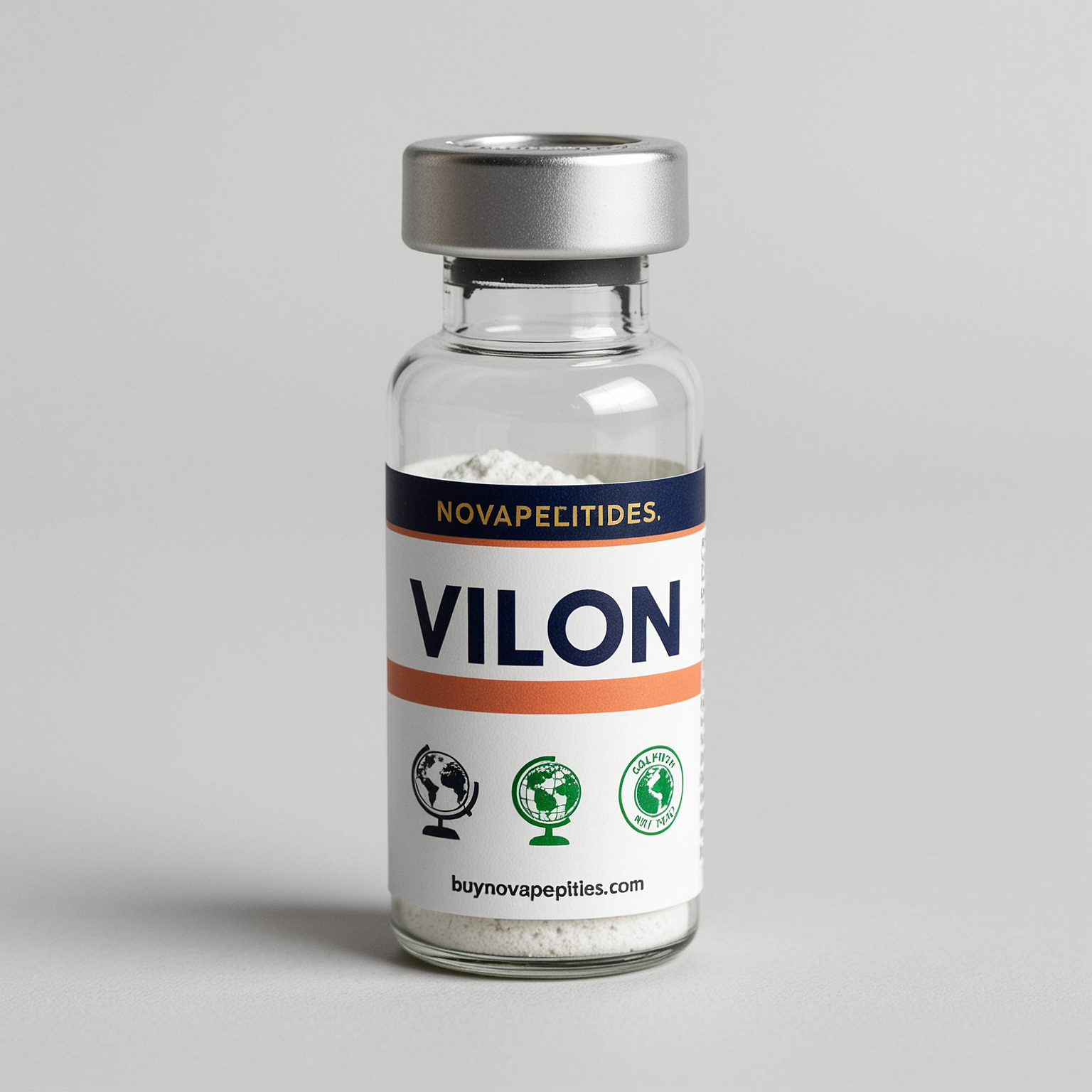
Vilon Peptide (Lys-Glu) – Thymic Bioregulator for Immune Research | Buy Nova Peptides

$75.00
Synthetic dipeptide bioregulator for immune and epigenetic research. Vilon (Lys-Glu, KE) is a 2-amino-acid peptide developed by Professor Khavinson. Studied for its effects on chromatin structure, gene expression regulation, and immune cell differentiation in aging research.
- 2-amino-acid dipeptide (Lysyl-Glutamic acid)
- Synthetic bioregulator derived from thymus research
- Studied for chromatin remodeling effects
- Epigenetic gene expression modulation
- Lyophilized powder for laboratory research
Vilon: The Minimalist Dipeptide Bioregulator for Immune and Epigenetic Research
Vilon represents a remarkable achievement in peptide bioregulator research—a synthetic dipeptide containing just two amino acids that demonstrates measurable biological activity. Officially designated as Lys-Glu (lysyl-glutamic acid) or abbreviated KE, Vilon was developed by Professor Vladimir Khavinson and colleagues at the St. Petersburg Institute of Bioregulation and Gerontology as part of Russia’s extensive research program into short peptide bioregulators. Despite its minimalist structure, this compound has been studied for effects on immune function, chromatin remodeling, and even lifespan extension in animal models.
The discovery of Vilon emerged from the systematic analysis of thymic peptides, specifically the identification of active components within the larger Thymalin complex. Khavinson’s research group found that the Lys-Glu sequence contributed significantly to Thymalin’s immunomodulatory effects. By isolating and synthesizing this minimal active unit, they created a compound that could be produced economically while retaining biological activity. This approach exemplifies the bioregulator concept: identifying the smallest effective peptide sequences that can normalize cellular function.
Molecular Structure and Properties
Vilon is chemically the simplest peptide in the Khavinson bioregulator catalog, consisting of just two amino acid residues: lysine (Lys, K) and glutamic acid (Glu, E). The full chemical designation is L-lysyl-L-glutamic acid, indicating that both amino acids are in the natural L-configuration and joined by a standard peptide bond.
The molecular weight of Vilon is approximately 275 daltons—orders of magnitude smaller than typical therapeutic proteins. This minimal size has important implications: the peptide can be synthesized with high purity at low cost, demonstrates excellent tissue penetration, and is unlikely to trigger immune responses that complicate administration of larger foreign proteins.
Despite its simplicity, Vilon is not merely a nutritional supplement providing free amino acids. The peptide bond creates a distinct molecular entity with biological properties different from its constituent amino acids. Research suggests that the specific Lys-Glu sequence, rather than the individual amino acids, is responsible for the observed biological effects.
Mechanism: Chromatin Remodeling and Gene Expression
The proposed mechanism of Vilon action differs fundamentally from receptor-based signaling pathways typical of hormone-mimetic peptides. Instead, research indicates that the dipeptide interacts directly with chromatin—the DNA-protein complex that packages genetic material within the cell nucleus.
Studies published in Biogerontology demonstrated that Vilon induces “reactivation of chromatin” in cultured lymphocytes from elderly donors. Specifically, the peptide appears to promote deheterochromatinization—the process by which condensed, transcriptionally silent regions of DNA become more open and accessible. This chromatin remodeling can reactivate genes that have been silenced during aging.
The mechanism involves:
- DNA binding: The Lys-Glu dipeptide appears to interact with specific DNA sequences, particularly in gene promoter regions
- Chromatin decondensation: The peptide promotes structural changes that make DNA more accessible to transcription machinery
- Gene activation: Resulting changes in chromatin structure can increase expression of genes involved in immune function and cellular maintenance
- Epigenetic modulation: Effects on chromatin structure represent a form of epigenetic regulation that can persist beyond the peptide’s presence
This direct DNA-interaction mechanism is shared with other Khavinson bioregulators and represents a distinct paradigm from classical receptor-mediated pharmacology. The peptide essentially functions as a gene expression modulator, restoring more youthful patterns of gene activity in aging cells.
Immune System Research Applications
Vilon was originally developed as an immunomodulatory agent, and much of the research literature focuses on its effects on immune cells and function. The peptide has been studied for its ability to influence T-cell development, lymphocyte proliferation, and immune cell differentiation.
Key findings from immune research include:
- T-cell markers: Studies reported increased expression of the lymphocyte differentiation marker CD5 in cultured thymus cells exposed to Vilon
- Monocyte/macrophage function: Research on the THP-1 cell line examined effects on inflammatory pathways and proliferative activity
- Immune aging: Russian clinical studies in elderly patients reported improvements in immune parameters including T-cell counts and CD4/CD8 ratios
- Thymic function: The peptide has been studied for potential restoration of thymic activity in aging models
The immune effects are thought to result from both direct cellular actions and the broader epigenetic changes that restore more youthful gene expression patterns in immune cells. This dual mechanism—direct cellular effects plus epigenetic reprogramming—may explain why such a small molecule can produce significant biological outcomes.
Longevity and Cancer Research
Perhaps the most striking research findings with Vilon involve lifespan and tumor studies in rodents. A landmark study by Khavinson and Anisimov, published in Doklady Biological Sciences, reported that Vilon administration to female CBA mice produced two significant outcomes: inhibition of spontaneous tumor growth and extension of lifespan.
In this research, mice received subcutaneous Vilon starting at six months of age. Treated animals showed:
- Reduced tumor incidence: Lower rates of spontaneous tumor development compared to control animals
- Delayed tumor onset: When tumors did occur, they appeared later in life
- Increased lifespan: Modest but statistically significant extension of maximum lifespan
- Improved physical activity: Treated mice maintained higher activity levels in old age
The dual benefit—anticancer effects plus longevity extension—suggests that Vilon may act on fundamental aging processes rather than merely treating specific diseases. The mechanism likely involves the epigenetic reprogramming and immune enhancement described above, both of which could contribute to improved healthspan and lifespan.
Vilon in the Context of Bioregulator Research
Vilon occupies a unique position within the Khavinson bioregulator family. While most bioregulators are extracts or short peptides derived from specific tissues (Thymalin from thymus, Epithalamin from pineal, etc.), Vilon is a purely synthetic dipeptide identified through analysis of thymic extracts but produced independently.
Comparison with related compounds illuminates its characteristics:
Thymogen (Glu-Trp) is another dipeptide bioregulator from the same research program. Where Vilon contains Lys-Glu, Thymogen contains Glu-Trp. The two are often studied together to compare structure-activity relationships and synergistic effects.
Thymalin is the complete thymic extract from which Vilon’s active sequence was originally identified. While Thymalin contains multiple active components, Vilon represents a defined, pure compound with reproducible composition.
Epitalon (Ala-Glu-Asp-Gly) is a tetrapeptide bioregulator from pineal tissue with different target tissues but similar epigenetic mechanisms. Together, these compounds demonstrate that short peptides can function as tissue-specific gene expression regulators.
Research Protocols and Considerations
Laboratories working with Vilon should appreciate both its simplicity and its unique mechanism. As a highly stable dipeptide, it is less susceptible to degradation than larger peptides, but standard storage protocols (refrigerated, protected from light) remain advisable.
Standard reconstitution uses bacteriostatic water or sterile saline. The peptide’s small size and hydrophilic nature provide excellent solubility. Research protocols in the literature have employed various administration routes and schedules, with subcutaneous injection being most common in animal studies.
Because Vilon acts through epigenetic mechanisms that may have delayed or persistent effects, research designs should consider:
- Time-course studies: Effects on chromatin structure and gene expression may develop over days to weeks
- Washout periods: Epigenetic changes can persist after peptide removal
- Endpoint selection: Gene expression, chromatin markers, and functional outcomes may show different time courses
- Age models: Effects may be more pronounced in older animals or cells with established epigenetic dysregulation
As with all research peptides, Vilon is intended strictly for laboratory investigation and is not approved for human use.
Current Research Status and Future Directions
Vilon remains an active subject of research within the bioregulator field. Current investigations explore its mechanisms in greater detail, its interactions with other bioregulators, and its potential applications in models of immune dysfunction and aging.
The peptide’s ability to induce chromatin remodeling with just two amino acids makes it a valuable tool for studying epigenetic regulation. Researchers continue to investigate the specific DNA sequences and chromatin regions affected by Vilon, as well as the structural basis for its chromatin interactions.
The longevity and anticancer findings from rodent studies continue to generate interest in the geroscience community. While translation to human applications remains distant, the basic science of how short peptides can influence aging processes remains an active and important research area.
Browse our complete selection of research peptides and bioregulators for your laboratory studies. Visit our homepage to discover the latest additions to our research catalog.
References
- Khavinson VKh, Anisimov VN. “A synthetic dipeptide vilon (L-Lys-L-Glu) inhibits growth of spontaneous tumors and increases life span of mice.” Doklady Biological Sciences. https://www.researchgate.net/publication/12375506
- Lezhava T, et al. “Bioregulator Vilon-induced reactivation of chromatin in cultured lymphocytes from old people.” Biogerontology. 2004;5(2):73-9. https://pubmed.ncbi.nlm.nih.gov/15105581/
- “Peptides Regulating Proliferative Activity and Inflammatory Pathways in the Monocyte/Macrophage THP-1 Cell Line.” NCBI PMC. https://pmc.ncbi.nlm.nih.gov/articles/PMC8999041/
- “Peptide bioregulators: A new class of geroprotectors.” Advances in Gerontology, Springer Nature. https://link.springer.com/article/10.1134/S2079057013030065
- “Khavinson Peptides.” Wikipedia. https://en.wikipedia.org/wiki/Khavinson_peptides
Disclaimer: This product is sold for laboratory research purposes only. Vilon is not intended for human consumption, medical treatment, or diagnostic use. This information is provided for educational purposes and does not constitute medical or scientific advice. Always consult relevant scientific literature and follow proper laboratory safety protocols.
| Dosage | 20mg |
|---|
Be the first to review “Vilon Peptide (Lys-Glu) – Thymic Bioregulator for Immune Research | Buy Nova Peptides”
Related products

Uncategorized
Uncategorized


Uncategorized

Reviews
There are no reviews yet.