
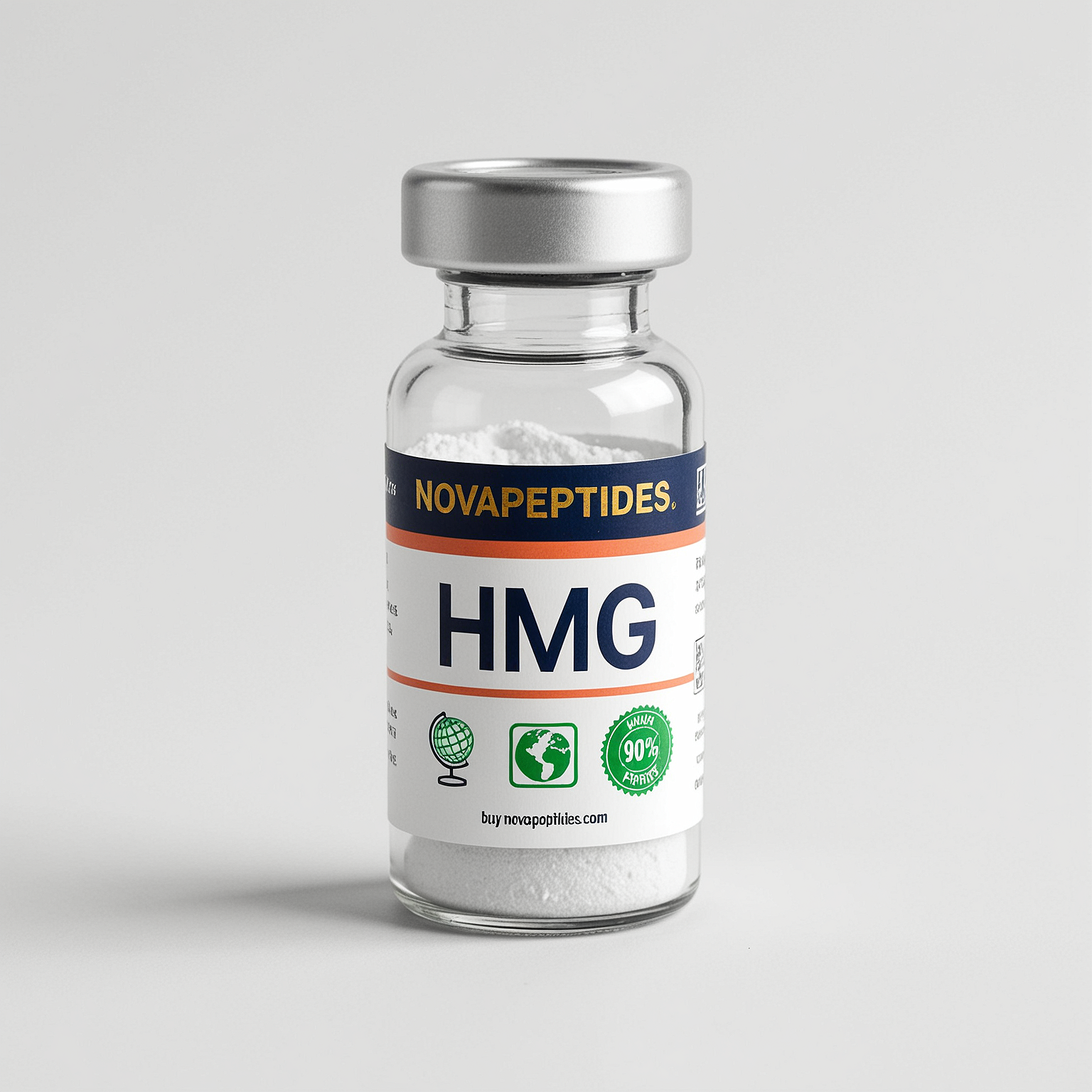
HMG: The Human Menopausal Gonadotropin Fertility Preparation

$70.00
HMG (Human Menopausal Gonadotropin, Menotropins) is a naturally derived fertility medication extracted and purified from the urine of postmenopausal women, containing both follicle-stimulating hormone (FSH) and luteinizing hormone (LH) in approximately 1:1 ratio. Each vial typically provides 75 IU FSH and 75 IU LH activity. HMG acts directly on gonadal tissue through FSH receptors (on ovarian granulosa cells and testicular Sertoli cells) and LH receptors (on ovarian theca cells and testicular Leydig cells), stimulating follicular development, estradiol production, and ovulation in women, and supporting spermatogenesis in men. As one of the foundational gonadotropin preparations in assisted reproductive technology, HMG remains a critical tool for controlled ovarian stimulation in IVF, intrauterine insemination, and ovulation induction protocols.
HMG: The Natural Dual Gonadotropin for Reproductive Research
HMG represents one of the most fascinating intersections of endocrinology and pharmaceutical science—a medication literally extracted from human biological waste that has enabled millions of births worldwide. Human Menopausal Gonadotropin, or Menotropins, harnesses the hormonal profile of postmenopausal women (who paradoxically have high gonadotropin levels due to loss of negative feedback) to treat fertility disorders in younger women and men. For researchers investigating ovarian physiology, spermatogenesis, and the pharmacology of natural versus recombinant gonadotropins, HMG offers a complex, biologically active preparation that continues to play a central role in reproductive medicine despite the availability of pure recombinant alternatives.
Origin and Extraction
The story of HMG begins with a serendipitous observation: the urine of postmenopausal women contains high concentrations of FSH and LH. After menopause, the loss of ovarian negative feedback causes the pituitary to secrete dramatically elevated levels of these gonadotropins, which are then excreted in urine.
As documented in Wikipedia and ScienceDirect, “Menotropins are extracted from the urine of postmenopausal women.” The extraction process involves:
- Collection: Urine from postmenopausal donors
- Protein Precipitation: Removal of urinary proteins
- Chromatographic Purification: Isolation of gonadotropin fractions
- Lyophilization: Freeze-drying to produce stable powder
- Standardization: Assay to ensure 75 IU FSH and 75 IU LH per ampoule
This natural extraction yields a preparation with both FSH and LH activity, distinct from recombinant products that provide only FSH (Gonal-F, Follistim) or pure LH.
Molecular Composition and Hormonal Content
HMG contains two distinct glycoprotein hormones:
Follicle-Stimulating Hormone (FSH): A heterodimeric glycoprotein consisting of alpha and beta subunits. The alpha subunit is shared with LH, TSH, and hCG, while the beta subunit confers FSH-specific activity. In HMG, FSH stimulates:
- Ovarian follicular recruitment and growth
- Granulosa cell proliferation
- Estradiol synthesis
- Inhibin production
- Sertoli cell function and spermatogenesis support (in males)
Luteinizing Hormone (LH): Structurally similar to FSH but with a distinct beta subunit. In HMG, LH contributes:
- Theca cell stimulation and androgen production
- Granulosa cell luteinization
- Final follicle maturation
- Ovulation triggering (when combined with HCG)
- Leydig cell testosterone production (in males)
Research published in ScienceDirect confirms that HMG “acts on luteinizing hormone (LH) and follicle-stimulating hormone (FSH) receptors.”
Mechanism of Action: Dual Receptor Activation
HMG exerts its effects through two distinct G protein-coupled receptor systems:
FSH Receptor (FSHR): Primarily expressed on ovarian granulosa cells and testicular Sertoli cells. Activation stimulates:
- cAMP production via Gs coupling
- Aromatase upregulation (converting androgens to estrogens)
- Granulosa cell proliferation
- Follicular fluid accumulation
- Inhibin/activin modulation
LH Receptor (LHR): Expressed on ovarian theca cells, Leydig cells, and granulosa cells (later in follicular development). Activation stimulates:
- cAMP production
- Androgen synthesis (theca cells)
- Testosterone production (Leydig cells)
- Final oocyte maturation
As documented in Peptide Database, “FSH stimulates growth and maturation of ovarian follicles containing eggs in women, and promotes spermatogenesis in men. LH stimulates ovulation and corpus luteum formation in women, and Leydig cell testosterone production.”
Clinical Applications in Female Fertility
HMG serves multiple roles in female reproductive medicine:
Controlled Ovarian Stimulation (COS): The primary use of HMG is stimulating multiple follicle development in IVF and IUI cycles. The dual FSH/LH content theoretically provides more “natural” stimulation than FSH alone.
Ovulation Induction: For women with anovulation (PCOS, hypothalamic amenorrhea), HMG can induce follicular development when oral agents (clomiphene, letrozole) fail.
LH Supplementation: In protocols using recombinant FSH, HMG may be added to provide LH activity, particularly in poor responders.
Research in NCBI Bookshelf discusses meta-analyses comparing “follicle-stimulating hormone (FSH) and human menopausal gonadotropin (HMG) during in vitro fertilisation (IVF) treatment.”
Applications in Male Fertility
While less commonly discussed, HMG plays a critical role in male fertility treatment:
Hypogonadotropic Hypogonadism: Men with pituitary deficiency require both FSH and LH to stimulate spermatogenesis. HMG provides the FSH component (supporting Sertoli cells and sperm maturation), typically combined with HCG (providing LH activity for testosterone production).
Spermatogenesis Restart: After testosterone replacement therapy suppression, HMG with HCG can restart sperm production.
As noted in PeptideDeck, “HMG supplies FSH plus LH and is used to grow follicles or restart spermatogenesis.”
Comparison with Recombinant FSH
The development of recombinant FSH (rFSH) products raised questions about HMG‘s continued relevance:
| Feature | HMG | Recombinant FSH |
|---|---|---|
| Source | Human urine | Genetically engineered cells |
| Hormone Content | FSH + LH | FSH only |
| Purity | ~95% (contains urinary proteins) | >99% (pure FSH) |
| Immunogenicity | Potentially higher | Lower |
| Cost | Generally lower | Higher |
Despite rFSH availability, HMG remains widely used, particularly in protocols emphasizing the potential benefits of combined FSH/LH stimulation.
Research Applications
HMG serves as a research tool for:
- Ovarian Physiology: Studies of follicular development and hormone interactions
- Spermatogenesis: Investigation of FSH’s role in male gamete production
- Gonadotropin Pharmacology: Comparison of natural vs. recombinant hormones
- Endocrinology: Research on hypothalamic-pituitary-gonadal axis function
- Assisted Reproduction: Optimization of stimulation protocols
For researchers investigating reproductive endocrinology, gonadotropin action, and fertility treatment, explore our comprehensive selection at Buy Nova Peptides Shop or visit Buy Nova Peptides for additional research compounds.
References and Scientific Literature
- Lunenfeld, B. (2004). “Historical perspectives in gonadotrophin therapy.” Human Reproduction Update, 10(6), 453-467.
- Van Wely, M., et al. (2011). “Human menopausal gonadotropin versus recombinant follicle stimulation hormone for ovarian stimulation in assisted reproductive cycles.” Cochrane Database of Systematic Reviews.
- NCBI Bookshelf. “Follicle-stimulating hormone or human menopausal gonadotropin for ovarian stimulation in in vitro fertilization cycles: a meta-analysis.” NCBI
- Wikipedia Contributors. “Menotropin.” Wikipedia. Wikipedia
- ScienceDirect Topics. “Human Menopausal Gonadotropin.” ScienceDirect
- PeptideDeck. “HMG (Human Menopausal Gonadotropin / Menotropins).” PeptideDeck
- Peptide Database. “HMG Overview, Dosing & Safety.” Peptide Database
- Google Scholar. “HMG human menopausal gonadotropin FSH LH fertility IVF.” Google Scholar
Disclaimer: This content is provided for educational and research purposes only. HMG is FDA-approved for fertility treatment under medical supervision. This information does not constitute medical advice, treatment recommendations, or protocols for self-administration. Always consult qualified healthcare professionals and comply with applicable regulations governing fertility medications.
| Dosage | 75iu |
|---|
Be the first to review “HMG: The Human Menopausal Gonadotropin Fertility Preparation”
Related products

Uncategorized



Reviews
There are no reviews yet.