
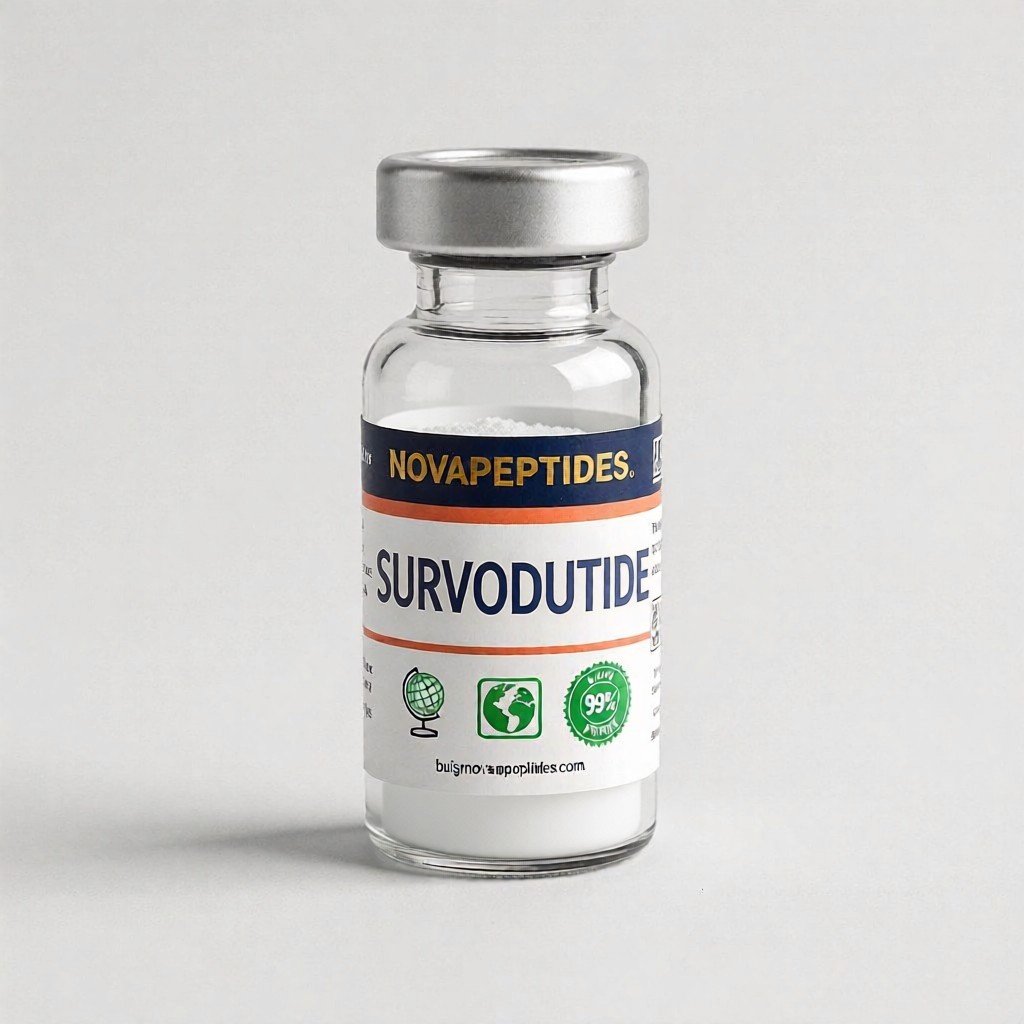
Survodutide Peptide – Dual Glucagon/GLP-1 Agonist for Metabolic Research | Buy Nova Peptides

$200.00
Dual glucagon/GLP-1 receptor agonist peptide for metabolic research. Survodutide (BI 456906) is a 29-amino-acid peptide engineered from the glucagon backbone with GLP-1 receptor activity. Studied for metabolic dysfunction, hepatic fat metabolism, and energy homeostasis research.
- 29-amino-acid dual receptor agonist peptide
- Targets glucagon receptor (GCGR) and GLP-1 receptor (GLP-1R)
- Once-weekly subcutaneous administration profile
- Developed by Boehringer Ingelheim and Zealand Pharma
- Lyophilized powder for laboratory research
Survodutide: The Dual Glucagon/GLP-1 Receptor Agonist for Metabolic Research
Survodutide (development code BI 456906) represents a new class of metabolic peptide therapeutics—a dual agonist simultaneously targeting the glucagon receptor (GCGR) and glucagon-like peptide-1 receptor (GLP-1R). This 29-amino-acid peptide, developed through a collaboration between Boehringer Ingelheim and Zealand Pharma, has entered advanced clinical trials for metabolic dysfunction-associated conditions. Survodutide differs from other dual agonists in the incretin class by being derived from the glucagon backbone rather than oxyntomodulin, creating a distinct pharmacological profile.
The peptide’s architecture incorporates strategic amino acid substitutions at positions 18, 20, and 23 that confer GLP-1 receptor activity while maintaining strong glucagon receptor binding. Additional modifications at position 16 incorporate exendin-4 characteristics, and acylation with a C18 fatty diacid enables albumin binding that extends the half-life to support once-weekly dosing. This structural engineering produces a molecule with unique receptor signaling properties that researchers are investigating for metabolic disease applications.
Molecular Structure and Design
Survodutide is built upon the native glucagon sequence—a 29-amino-acid peptide secreted by pancreatic alpha cells that primarily stimulates hepatic glucose output. The engineering challenge was maintaining glucagon’s metabolic effects while adding GLP-1 receptor activity without compromising stability or receptor selectivity. Cryogenic electron microscopy studies have revealed how these modifications alter receptor binding conformations compared to native glucagon.
The key structural modifications include:
- Positions 18, 20, 23: Amino acid substitutions introducing GLP-1 receptor recognition motifs
- Position 16: Modification incorporating exendin-4-like properties for enhanced stability
- N-terminal: His-{1-Aminocyclobutanecarboxylic acid} substitution for DPP-4 resistance
- C-terminal extension: Acylation with C18 diacid for albumin binding and extended half-life
This design yields a peptide with EC50 values of 0.52 nM for the glucagon receptor and 0.33 nM for the GLP-1 receptor in cellular assays, indicating potent activity at both targets. The balanced dual agonism distinguishes Survodutide from selective GLP-1 agonists like semaglutide or GIP/GLP-1 co-agonists like tirzepatide.
Mechanism of Action
The therapeutic rationale for dual glucagon/GLP-1 agonism rests on the complementary metabolic effects of these two hormone pathways. GLP-1 receptor activation reduces appetite, slows gastric emptying, and enhances glucose-dependent insulin secretion. Glucagon receptor activation, conversely, increases energy expenditure, promotes hepatic fat oxidation, and directly targets liver metabolism.
Survodutide engages both pathways simultaneously:
- Energy intake reduction: GLP-1 receptor signaling in hypothalamic appetite centers decreases food consumption
- Energy expenditure increase: Glucagon receptor activation raises metabolic rate through thermogenic effects
- Hepatic fat metabolism: Direct glucagon receptor action on hepatocytes promotes lipolysis and beta-oxidation
- Glycemic control: Combined receptor effects improve glucose homeostasis through multiple mechanisms
The hepatic targeting is particularly significant. While GLP-1 receptor agonists produce weight loss primarily through central appetite suppression, Survodutide’s glucagon component adds direct liver metabolic effects. This dual mechanism may explain the substantial hepatic fat reductions observed in clinical trials, with implications for metabolic dysfunction-associated steatohepatitis (MASH) research.
Clinical Research and Trial Data
The clinical development program for Survodutide has generated substantial data through Phase 2 and Phase 3 trials. The SYNCHRONIZE program evaluates obesity outcomes, while the SYNCHRONIZE-1 trial specifically examined weight loss in adults with obesity or overweight without type 2 diabetes.
Key findings from published trials include:
- Phase 2 obesity trial: Participants achieved up to 18.7% mean weight reduction at 46 weeks with the 4.8mg dose
- SYNCHRONIZE-1 Phase 3: Average weight loss of 16.6% (39.2 lb / 17.8 kg) at 76 weeks
- Waist circumference: Significant reductions in a key cardiometabolic risk predictor
- Metabolic markers: Improvements in glycemic control, lipid profiles, and inflammatory markers
The MASH (formerly NASH) development program has generated equally compelling results. In the Phase 2 SUBMARINE trial published in the New England Journal of Medicine, Survodutide achieved MASH resolution without fibrosis worsening in up to 83% of patients at 48 weeks with the 4.8mg dose. This represents one of the highest response rates reported in MASH clinical trials and suggests the glucagon receptor component provides liver-specific benefits beyond weight loss.
Survodutide vs. Other Incretin-Based Peptides
Understanding Survodutide’s position requires comparison with other advanced metabolic peptides:
Semaglutide (Wegovy/Ozempic) is a selective GLP-1 receptor agonist that produces approximately 15% weight loss at 68 weeks. It lacks glucagon receptor activity, meaning it does not directly target hepatic metabolism or energy expenditure through that pathway.
Tirzepatide (Zepbound/Mounjaro) is a GIP/GLP-1 dual agonist that achieves approximately 20-22% weight loss. Its mechanism combines GLP-1 effects with GIP receptor activation, which potentiates insulin secretion and may have additional metabolic benefits. However, it does not activate glucagon receptors.
Survodutide occupies a distinct mechanistic niche. By activating glucagon rather than GIP receptors, it targets hepatic fat metabolism and energy expenditure through pathways the other agents do not engage. This creates potential advantages for conditions where liver fat reduction is a primary endpoint, such as MASH.
Research Applications and Considerations
Laboratory research with Survodutide focuses on understanding dual receptor pharmacology and its metabolic consequences. Key research areas include receptor signaling kinetics, tissue-specific effects, and interactions between glucagon and GLP-1 pathways.
The peptide’s extended half-life from albumin binding creates a pharmacokinetic profile suited for once-weekly administration in research models. This differs from native glucagon, which has a plasma half-life of only minutes. Researchers should account for this prolonged exposure when designing experimental protocols.
Standard reconstitution uses bacteriostatic water, with the resulting solution typically administered via subcutaneous injection in animal models. Storage requirements follow standard peptide protocols: lyophilized powder should be kept refrigerated and protected from light, with reconstituted solutions used within established timeframes.
Safety Profile and Limitations
Clinical trial data indicates Survodutide shares the gastrointestinal side effect profile common to GLP-1 receptor agonists, including nausea, vomiting, and diarrhea, particularly during dose escalation. These effects are generally transient and dose-dependent.
The glucagon receptor activation raises theoretical concerns about hyperglycemia, as native glucagon increases hepatic glucose output. However, the GLP-1 receptor component counterbalances this effect, and clinical trials have not shown problematic glycemic elevations. The net effect on glucose homeostasis appears favorable.
Gallbladder-related events and injection site reactions have been observed at rates comparable to other peptides in this class. As with all investigational compounds, the complete safety profile will emerge from larger and longer-duration studies.
Current Development Status
Survodutide remains in Phase 3 clinical development as of 2026, with regulatory submissions anticipated based on trial outcomes. The SYNCHRONIZE program continues enrolling participants for obesity indications, while the MASH program advances toward potential regulatory filings.
For research laboratories, Survodutide represents an important tool for investigating dual receptor agonism in metabolic disease models. Its availability as a research peptide enables mechanistic studies that complement clinical trial data, helping elucidate how glucagon and GLP-1 receptor co-activation produces metabolic effects.
Browse our complete catalog of research peptides and metabolic compounds for your laboratory studies. Visit our homepage to see the latest additions to our research collection.
References
- “A Phase 2 Randomized Trial of Survodutide in MASH and Fibrosis.” New England Journal of Medicine. https://www.nejm.org
- “Survodutide (BI 456906): GLP1/GCGR agonist.” Boehringer Ingelheim Clinical Pipeline. https://www.boehringer-ingelheim.com
- “Survodutide – Pipeline.” Zealand Pharma. https://www.zealandpharma.com
- “Survodutide.” Wikipedia. https://en.wikipedia.org/wiki/Survodutide
- “The Molecular Basis of Survodutide (BI456906) Glucagon/GLP-1 Receptor Dual Agonism.” ResearchGate. https://www.researchgate.net
Disclaimer: This product is sold for laboratory research purposes only. Survodutide is not intended for human consumption, medical treatment, or diagnostic use. It is an investigational compound not approved by regulatory authorities for human use. This information is provided for educational purposes and does not constitute medical or scientific advice. Always consult relevant literature and follow proper laboratory safety protocols.
| Dosage | 10mg |
|---|
Be the first to review “Survodutide Peptide – Dual Glucagon/GLP-1 Agonist for Metabolic Research | Buy Nova Peptides”
Related products
Uncategorized


Uncategorized


Reviews
There are no reviews yet.