
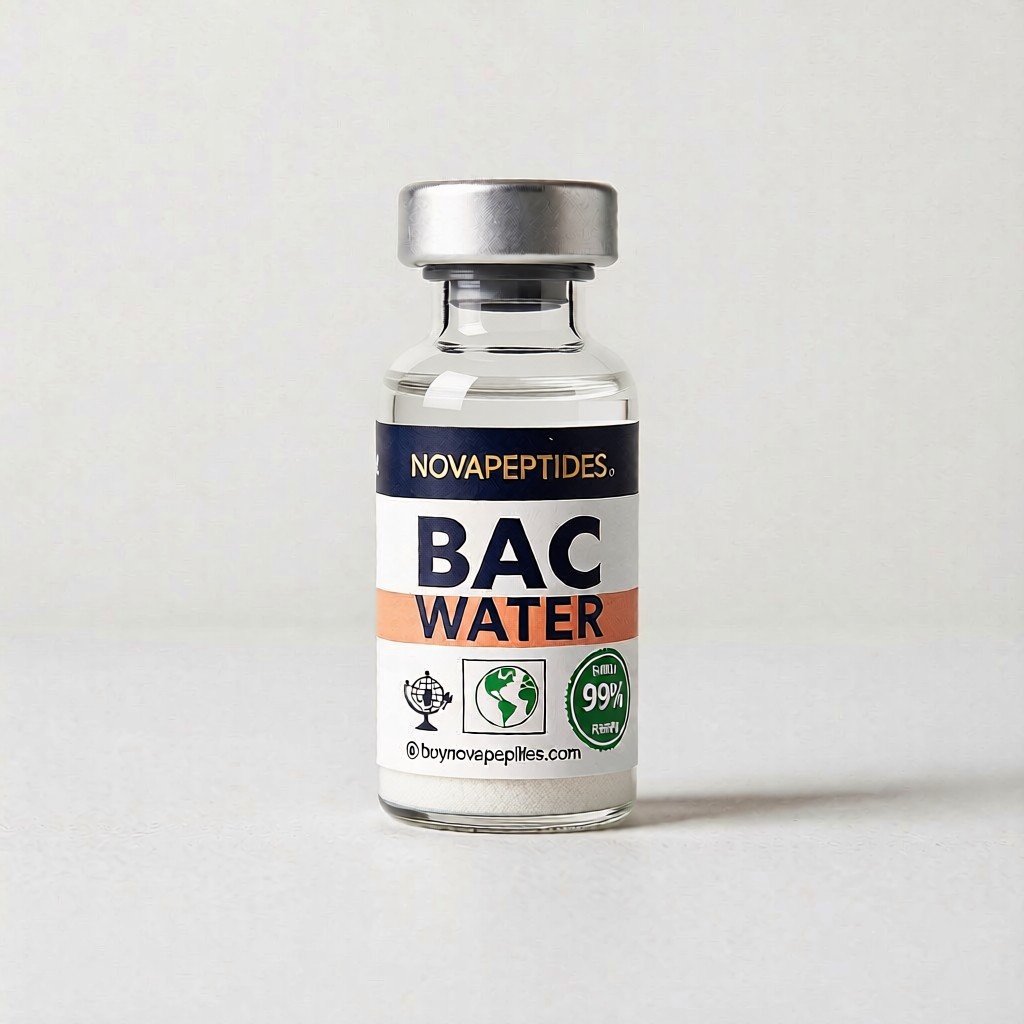
BAC Water (Bacteriostatic Water) for Peptide Reconstitution | Buy Nova Peptides

Price range: $9.00 through $11.00
Pharmaceutical-grade BAC water for peptide reconstitution. Sterile water containing 0.9% benzyl alcohol preservative that inhibits bacterial growth, enabling multi-use vial applications. Essential for laboratory research involving lyophilized peptides.
- 0.9% benzyl alcohol antimicrobial preservative
- Sterile, non-pyrogenic, USP-grade formulation
- Enables multi-dose vial usage
- Standard for peptide reconstitution
- 28-day stability after opening
BAC Water: The Essential Reconstitution Solution for Peptide Research
BAC water (bacteriostatic water) is sterile water for injection preserved with 0.9% benzyl alcohol, making it the laboratory standard for reconstituting lyophilized peptides and other research compounds. Unlike sterile water for injection (SWFI), which lacks preservatives and must be discarded after a single use, BAC water maintains antimicrobial protection that allows for multiple withdrawals from the same vial over an extended period.
Researchers working with peptides like BPC-157, TB-500, and other lyophilized compounds rely on BAC water as their primary reconstitution solvent. The benzyl alcohol preservative inhibits bacterial growth and microbial contamination, providing the stability necessary for multi-dose research applications where vials remain in use for days or weeks.
What Is BAC Water?
Bacteriostatic water for injection (BWFI) is a highly purified, sterile water solution manufactured under cGMP conditions with a pH typically ranging from 4.5 to 7.0. The defining characteristic is the inclusion of 0.9% benzyl alcohol, which functions as a bacteriostatic agent. This compound disrupts bacterial cell membrane integrity and inhibits microbial proliferation without necessarily killing existing organisms outright.
The antimicrobial mechanism of benzyl alcohol has been well-documented in pharmaceutical literature. Research published in Antimicrobial Agents and Chemotherapy demonstrates that benzyl alcohol interacts with bacterial surface structures differently than other alcohols, providing effective preservation at concentrations that remain compatible with most peptide formulations.
BAC Water vs. Sterile Water for Injection
Understanding the distinction between BAC water and sterile water for injection is critical for proper research protocol selection. Sterile water for injection contains no preservatives and is intended for single-use applications. Once the seal is broken, SWFI must be used immediately or discarded, as it provides no protection against microbial contamination.
BAC water, conversely, maintains antimicrobial activity for up to 28 days after initial entry when stored properly at 2-8°C. This extended usability makes it the practical choice for research protocols requiring multiple administrations from the same vial. The benzyl alcohol concentration of 0.9% provides sufficient preservation without compromising the stability of most research peptides.
Saline solution (0.9% sodium chloride) represents another alternative, though it contains no preservative unless specifically labeled as bacteriostatic saline. For peptide reconstitution, pH-neutral BAC water is generally preferred over saline, as salt content can potentially affect peptide solubility and stability in certain compounds.
Applications in Peptide Research
The primary application for BAC water in laboratory settings is the reconstitution of lyophilized (freeze-dried) peptides. Most research peptides are supplied in powder form to maintain stability during shipping and storage. Before these compounds can be used in experimental protocols, they must be dissolved in an appropriate solvent.
Bacteriostatic water serves this function across a wide range of peptide categories:
- Regenerative peptides: BPC-157, TB-500, and related compounds
- Growth factor analogs: IGF-1 LR3, IGF-DES, CJC-1295
- Metabolic peptides: Semaglutide, Tirzepatide, Retatrutide
- Cosmetic peptides: GHK-Cu, Snap-8, Matrixyl
- Nootropic peptides: Semax, Selank, Dihexa
The versatility of BAC water stems from its neutral pH and isotonic compatibility with most peptide formulations. While some peptides require acidic solutions (such as acetic acid or bacteriostatic sodium chloride) for optimal solubility, the majority dissolve readily in standard bacteriostatic water.
Proper Handling and Storage Protocols
Maintaining the integrity of BAC water requires adherence to aseptic technique throughout the reconstitution process. All work surfaces should be sanitized, and sterile syringes and needles must be used for each withdrawal. The rubber stopper should be disinfected with alcohol before each needle entry to minimize contamination risk.
Storage guidelines are straightforward but critical for maintaining preservative efficacy:
- Store unopened vials at 2-8°C (refrigerated)
- Protect from light and freezing
- Discard vials 28 days after initial entry
- Do not use if solution appears cloudy or contains particulate matter
- Never use in neonates or for intrathecal injection
The 28-day usage window reflects the validated antimicrobial efficacy of the benzyl alcohol preservative system. Beyond this period, the bacteriostatic protection cannot be guaranteed, and contamination risk increases significantly.
Safety Considerations and Limitations
While BAC water is generally well-tolerated in research applications, certain limitations apply. Benzyl alcohol metabolism produces benzoic acid, which conjugates with glycine to form hippuric acid for renal excretion. This metabolic pathway functions efficiently in adult systems but is underdeveloped in neonates, creating the risk of benzyl alcohol accumulation and potential toxicity in this population.
Consequently, bacteriostatic water is contraindicated for use in neonates and for intrathecal (spinal) injection in any population. For these specific applications, preservative-free sterile water for injection is the required alternative.
Researchers should also note that benzyl alcohol, like other preservatives, can potentially affect protein stability in certain formulations. Studies published in Pharmaceutical Research have documented preservative-induced aggregation in some protein therapeutics, though this effect varies considerably by compound and concentration.
Quality Standards and Regulatory Status
Pharmaceutical-grade BAC water must meet USP (United States Pharmacopeia) standards for sterility, pyrogenicity, and particulate matter. Manufacturing occurs under current Good Manufacturing Practice (cGMP) conditions with validated sterilization processes, typically membrane filtration or autoclaving.
The FDA classifies bacteriostatic water for injection as a prescription-required product when intended for human use, though it is widely available for laboratory and research purposes. Quality indicators include clear, colorless appearance, proper labeling with lot numbers and expiration dates, and intact tamper-evident seals.
Why Researchers Choose BAC Water
The research community has standardized on BAC water for compelling practical reasons. The multi-dose capability reduces waste and cost when working with compounds requiring repeated administration. The antimicrobial protection provides peace of mind during extended research protocols. The neutral pH and compatibility profile suit the majority of peptide formulations.
For laboratories conducting peptide research, maintaining an adequate supply of bacteriostatic water is as essential as having the peptides themselves. Without proper reconstitution solvent, even the highest-quality lyophilized compounds cannot be prepared for experimental use.
Browse our complete selection of research peptides and reconstitution supplies to support your laboratory work. Visit our homepage for the latest additions to our catalog.
References
- Shenep JL, et al. “Antimicrobial properties of heparin-containing solutions.” PubMed. https://pubmed.ncbi.nlm.nih.gov
- “Benzyl Alcohol as a Pharmaceutical Preservative.” NCBI PMC. https://pmc.ncbi.nlm.nih.gov
- “Bacteriostatic Water for Injection.” U.S. Food and Drug Administration. https://www.fda.gov
- “Benzyl Alcohol.” Wikipedia. https://en.wikipedia.org/wiki/Benzyl_alcohol
- “Antimicrobial Preservatives for Protein and Peptide Formulations.” NIH National Center for Biotechnology Information. https://www.ncbi.nlm.nih.gov
Disclaimer: This product is sold for laboratory research purposes only. BAC water is not intended for human consumption, medical treatment, or diagnostic use. Always follow proper laboratory safety protocols and consult relevant literature before use. This information is provided for educational purposes and does not constitute medical or scientific advice.
| Dosage | 3ml, 10ml |
|---|
Be the first to review “BAC Water (Bacteriostatic Water) for Peptide Reconstitution | Buy Nova Peptides”
Related products
Uncategorized

Uncategorized


Reviews
There are no reviews yet.