
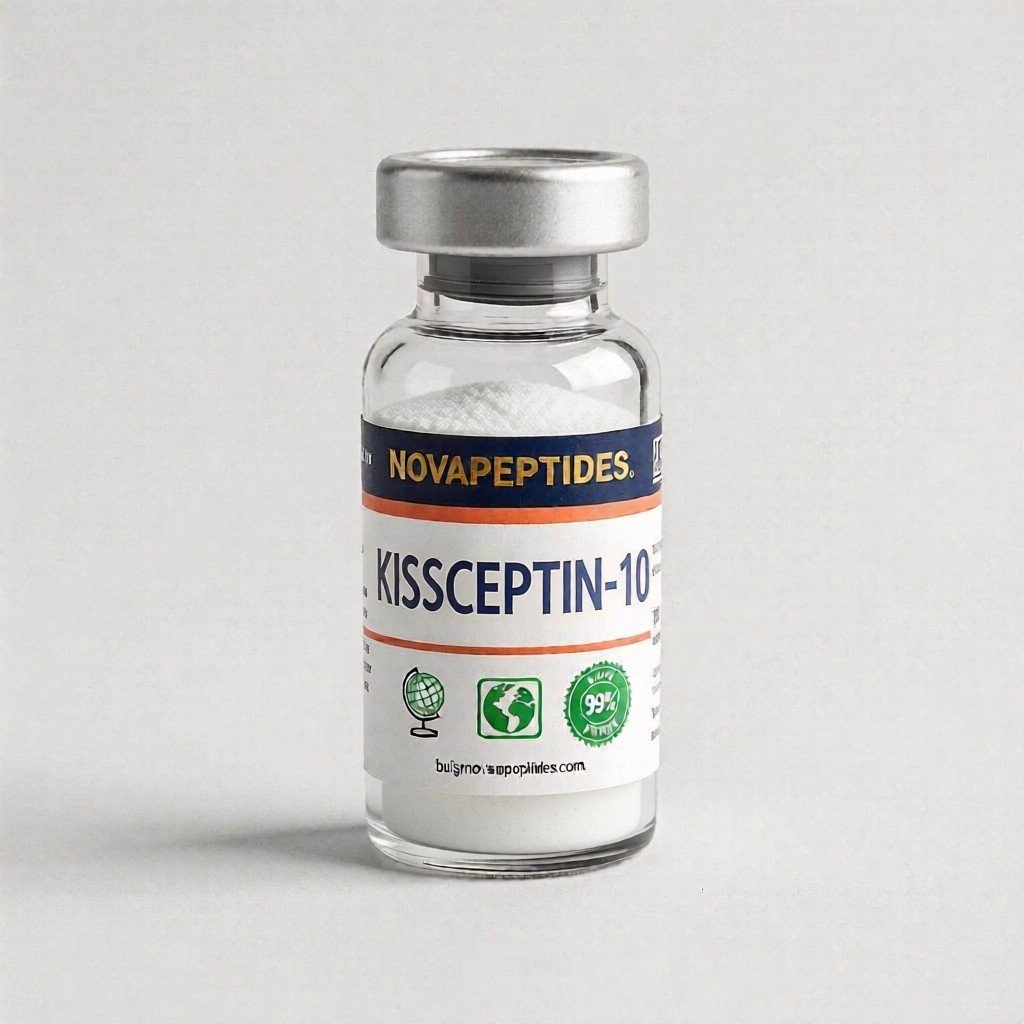
KissPeptin-10 Peptide – GnRH Stimulator for Reproductive Research | Buy Nova Peptides


Price range: $51.00 through $74.00
Neuropeptide activator of the hypothalamic-pituitary-gonadal axis. KissPeptin-10 (KP-10) is a 10-amino-acid decapeptide derived from the KISS1 gene that potently stimulates GnRH release through KISS1R activation. Essential for reproductive endocrinology and fertility research.
- 10-amino-acid neuropeptide (decapeptide)
- Potent agonist of KISS1R/GPR54 receptor
- Stimulates GnRH neuron activation
- Derived from KISS1 metastasis suppressor gene
- Lyophilized powder for laboratory research
KissPeptin-10: The Master Regulator of Reproductive Hormone Signaling
KissPeptin-10 (KP-10, Metastin 45-54) represents one of the most significant discoveries in reproductive neuroendocrinology of the past two decades. This 10-amino-acid neuropeptide serves as the minimal active fragment of the larger kisspeptin family, which occupies the apex of the reproductive hormone hierarchy. KissPeptin-10 binds to the KISS1R receptor (formerly GPR54) on hypothalamic neurons to trigger the release of gonadotropin-releasing hormone (GnRH), making it the essential gatekeeper for puberty onset, fertility, and reproductive function.
The discovery of KissPeptin-10’s role in reproduction emerged from an unexpected direction—cancer research. The KISS1 gene was originally identified in 1996 as a metastasis suppressor for melanoma, with its name derived from the location of its discovery (Hershey, Pennsylvania, home of Hershey’s Kisses chocolates). It wasn’t until 2001 that three independent research groups simultaneously identified kisspeptins as the endogenous ligands for the orphan G-protein-coupled receptor GPR54, revealing the molecule’s true physiological function as the master regulator of reproduction.
Molecular Structure and Processing
KissPeptin-10 is a linear amidated decapeptide with the amino acid sequence Tyr-Asn-Trp-Asn-Ser-Phe-Gly-Leu-Arg-Phe-NH2. This peptide represents the C-terminal fragment of kisspeptin-54 (metastin), which is itself cleaved from a 145-amino-acid prepropeptide encoded by the KISS1 gene. The amidated C-terminus is critical for biological activity, as is characteristic of most central nervous system-active peptides.
The full-length kisspeptin-54 undergoes proteolytic processing to generate several biologically active fragments:
- Kisspeptin-54 (metastin): The full-length 54-amino-acid peptide
- Kisspeptin-14: A 14-amino-acid fragment with equivalent receptor affinity
- Kisspeptin-13: A 13-amino-acid variant
- KissPeptin-10: The minimal active decapeptide with full biological potency
Remarkably, KissPeptin-10 retains the full receptor-binding and signaling capabilities of the longer forms, making it the most efficient tool for research applications. The shorter length also facilitates synthesis and improves pharmacokinetic properties for experimental use.
The KISS1R Receptor and Signaling Mechanism
The biological effects of KissPeptin-10 are mediated exclusively through the KISS1R receptor (also designated GPR54, AXOR12, or hOT7T175), a Gq/11-coupled G-protein-coupled receptor expressed primarily on GnRH neurons in the hypothalamus. This receptor coupling activates phospholipase C, generating inositol trisphosphate (IP3) and diacylglycerol (DAG), which trigger intracellular calcium release and protein kinase C activation.
The signaling cascade proceeds as follows: KissPeptin-10 binds to KISS1R on hypothalamic GnRH neurons, triggering a dramatic and prolonged depolarization that causes action potential firing. This neuronal activation releases GnRH into the hypophyseal portal circulation, which carries it to the anterior pituitary. There, GnRH stimulates gonadotroph cells to secrete luteinizing hormone (LH) and follicle-stimulating hormone (FSH), which in turn regulate gonadal function and sex steroid production.
Research indicates that KissPeptin-10 activates over 85% of GnRH neurons, making it the most potent and physiologically relevant stimulus for GnRH release identified. This explains why mutations in either the KISS1 gene or KISS1R receptor cause hypogonadotropic hypogonadism and failed puberty in humans—without functional kisspeptin signaling, the reproductive cascade cannot initiate.
Physiological Functions and Research Applications
The primary research application for KissPeptin-10 involves studying the hypothalamic-pituitary-gonadal (HPG) axis and its regulation. The peptide serves as a pharmacological probe to interrogate GnRH neuronal function, gonadotropin secretion patterns, and the neuroendocrine control of reproduction.
Key research areas include:
- Puberty onset mechanisms: Investigating the neurobiological triggers that activate GnRH secretion at puberty
- Gonadotropin secretion patterns: Studying the pulsatile release of LH and FSH and its modulation
- Sex steroid feedback: Examining how estrogen and testosterone regulate kisspeptin neurons
- Seasonal reproduction: Researching photoperiodic influences on reproductive hormone cycles
- Metabolic-reproductive interactions: Exploring links between energy balance and fertility
Beyond reproduction, KissPeptin-10 research extends to the peptide’s original discovery context—cancer biology. The KISS1 metastasis suppressor function operates through kisspeptin receptor signaling in certain tumor types, inhibiting cell migration and invasion. This dual functionality makes KissPeptin-10 relevant for both reproductive endocrinology and oncology research.
Clinical Research and Therapeutic Potential
Clinical trials have explored KissPeptin-10 and related kisspeptins for several fertility-related applications. The most extensively studied use involves oocyte maturation triggering during in vitro fertilization (IVF) protocols. Traditional IVF uses human chorionic gonadotropin (hCG) to trigger final oocyte maturation, but hCG’s prolonged activity (several days) increases the risk of ovarian hyperstimulation syndrome (OHSS), a potentially serious complication.
KissPeptin-10 offers a mechanistically distinct alternative. Because kisspeptin stimulates the body’s endogenous GnRH release rather than directly activating the LH receptor, it produces a more physiological LH surge that resolves within hours rather than days. Clinical studies have demonstrated that kisspeptin triggering achieves equivalent oocyte maturation rates with significantly reduced OHSS risk compared to hCG.
Additional clinical research directions include:
- Hypothalamic amenorrhea: Investigating kisspeptin replacement for functional hypothalamic infertility
- Delayed puberty: Exploring therapeutic potential for constitutional delay of growth and puberty
- Male hypogonadism: Studying effects on testosterone production and spermatogenesis
- Endometrial receptivity: Researching implantation and early pregnancy support
The brief duration of action that makes KissPeptin-10 safer for IVF triggering also limits its utility for sustained therapeutic effects, presenting formulation challenges for chronic conditions.
KissPeptin-10 vs. Other Kisspeptin Forms
Researchers can access several kisspeptin variants, each with distinct characteristics:
Kisspeptin-54 (metastin) is the full-length peptide used in many clinical trials. It offers longer duration of action due to reduced clearance but requires larger doses and more complex synthesis.
KissPeptin-10 provides equivalent receptor activation with superior pharmacokinetic properties for research. Its shorter sequence enables more precise dosing and cleaner experimental interpretation, as it eliminates potential confounding effects from additional amino acid residues.
Kisspeptin antagonists have also been developed for research applications requiring blockade of endogenous kisspeptin signaling, such as studying basal GnRH pulsatility or contraceptive development.
Research Protocol Considerations
Laboratory studies with KissPeptin-10 require attention to its peptide nature and route of administration. The molecule does not cross the blood-brain barrier effectively, meaning peripheral administration may not replicate central effects observed with direct hypothalamic delivery. Most research applications use subcutaneous or intravenous administration, with some specialized studies employing intracerebroventricular injection.
The peptide’s short half-life (minutes to hours depending on species) necessitates either continuous infusion protocols or acceptance of transient effects. This pharmacokinetic profile reflects rapid enzymatic degradation and renal clearance typical of small peptides.
Standard reconstitution uses bacteriostatic water, with storage of lyophilized powder under refrigeration and protection from light. As with all research peptides, KissPeptin-10 is strictly for laboratory research and not for human administration outside of approved clinical trials.
Safety and Limitations
Clinical trial data with kisspeptins indicates a favorable safety profile, with the most common effects being transient flushing and mild blood pressure changes related to vasodilation. The peptide’s short half-life means any adverse effects resolve quickly after administration stops.
However, KissPeptin-10’s potent stimulation of the reproductive axis means it can affect sex steroid production, with downstream implications for endometrial proliferation, spermatogenesis, and other hormone-sensitive tissues. Research protocols must account for these physiological effects.
The species specificity of kisspeptin sequences (human vs. rodent variants differ) requires attention when translating findings between animal models and human applications.
Current Research Frontiers
The kisspeptin field continues to evolve rapidly. Current research frontiers include understanding the neurocircuitry connecting kisspeptin neurons to GnRH neurons, identifying co-transmitters and modulators of kisspeptin signaling, and developing longer-acting analogs for therapeutic applications.
KissPeptin-10 remains the reference standard for mechanistic studies of kisspeptin receptor pharmacology. Its defined structure, potent activity, and established signaling mechanisms make it an essential tool for reproductive neuroendocrinology research.
Explore our full selection of research peptides and neuroendocrine compounds for your laboratory studies. Visit our homepage to discover the latest additions to our research catalog.
References
- Kotani M, et al. “The metastasis suppressor gene KiSS-1 encodes kisspeptins, the natural ligands of the orphan G protein-coupled receptor GPR54.” PubMed. https://pubmed.ncbi.nlm.nih.gov/11457843/
- “Kisspeptin and GPR54: Discovery of a Novel Pathway in Reproduction.” NCBI PMC. https://pmc.ncbi.nlm.nih.gov/articles/PMC2869294/
- “The Role of Kisspeptin in the Control of the Hypothalamic-Pituitary-Gonadal Axis and Reproduction.” Frontiers in Endocrinology. https://www.frontiersin.org
- “The kisspeptin-GnRH pathway in human reproductive health.” NCBI PMC. https://pmc.ncbi.nlm.nih.gov/articles/PMC4063702/
- “Kisspeptin.” Wikipedia. https://en.wikipedia.org/wiki/Kisspeptin
Disclaimer: This product is sold for laboratory research purposes only. KissPeptin-10 is not intended for human consumption, medical treatment, or diagnostic use. This information is provided for educational purposes and does not constitute medical or scientific advice. Always consult relevant scientific literature and follow proper laboratory safety protocols.
| Dosage | 5mg, 10mg |
|---|
Be the first to review “KissPeptin-10 Peptide – GnRH Stimulator for Reproductive Research | Buy Nova Peptides”
Related products

Uncategorized
Uncategorized

Uncategorized
Uncategorized
Reviews
There are no reviews yet.