
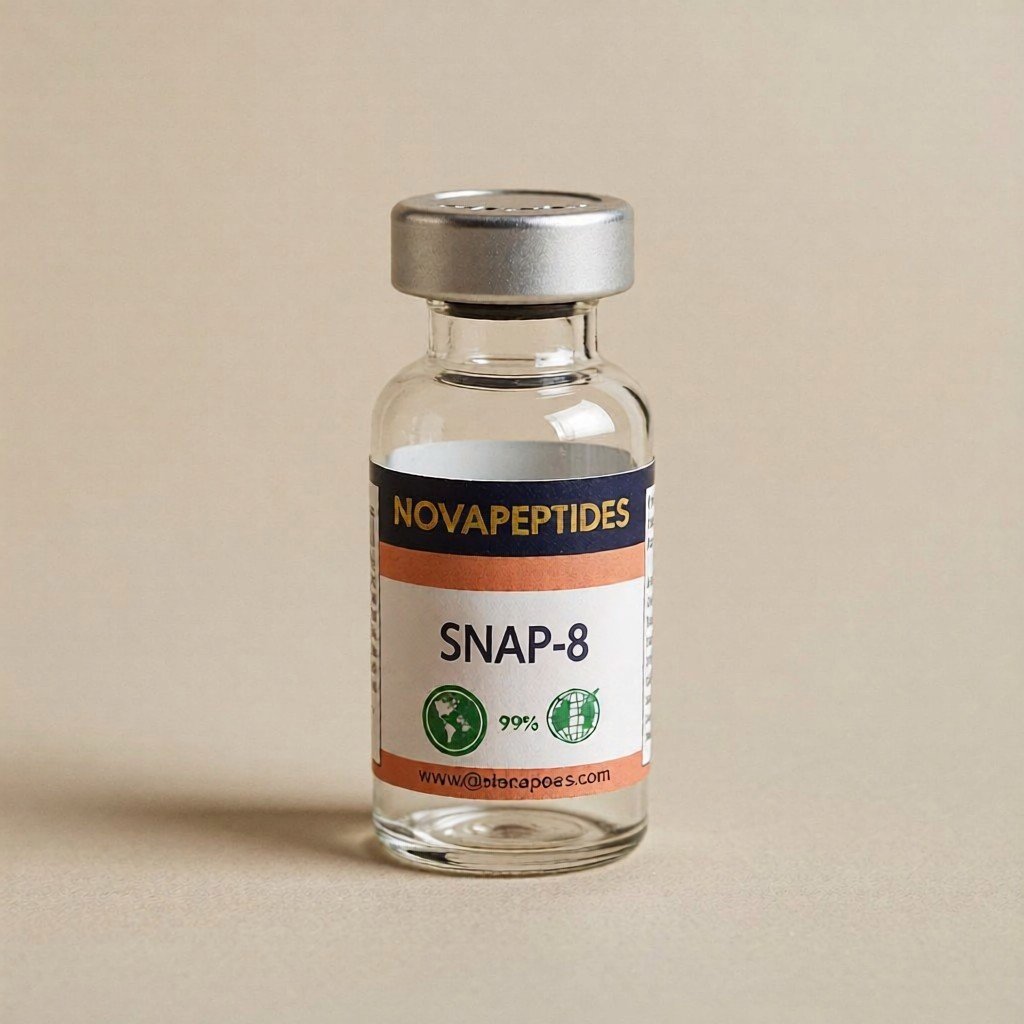
Snap-8: The Octapeptide for Expression Line Research

$37.00
Snap-8 (Acetyl Octapeptide-3, also known as Acetyl Glutamyl Heptapeptide-1) is a synthetic octapeptide designed as an advanced cosmetic ingredient for targeting expression lines and facial muscle contraction. Composed of eight amino acids with the sequence Ac-Glu-Glu-Met-Gln-Arg-Arg-Ala-Asp, Snap-8 functions as a competitive antagonist of SNAP-25, a protein essential for SNARE complex formation and acetylcholine release at the neuromuscular junction. By mimicking the N-terminal end of SNAP-25, Snap-8 competes for binding within the SNARE complex, theoretically modulating neurotransmitter release and attenuating muscle contractions that form expression lines. Research indicates Snap-8 is approximately 30% more potent than its predecessor Argireline (Acetyl Hexapeptide-3), offering enhanced efficacy for cosmetic formulations targeting forehead lines, crow’s feet, and glabellar wrinkles.
Snap-8: The Octapeptide That Targets Neuromuscular Signaling
Snap-8 represents an evolution in cosmetic peptide technology, building upon the foundation established by earlier neurotransmitter-modulating peptides to offer enhanced potency and efficacy. This synthetic octapeptide, also designated Acetyl Octapeptide-3 or Acetyl Glutamyl Heptapeptide-1, was specifically engineered to interfere with the molecular machinery of muscle contraction at the neuromuscular junction—the same biological target addressed by botulinum toxin injections, but through a fundamentally different, non-toxic mechanism. For researchers investigating cosmetic science, dermatological formulations, and the molecular biology of facial expression, Snap-8 provides a sophisticated tool for exploring the relationship between neurotransmitter signaling and skin appearance.
Molecular Structure and Design
The architecture of Snap-8 reflects rational peptide design aimed at optimizing interaction with the SNARE protein complex. The complete amino acid sequence is:
Ac-Glu-Glu-Met-Gln-Arg-Arg-Ala-Asp-NH2
This eight-amino-acid structure represents an extension of the hexapeptide Argireline (Acetyl Hexapeptide-3), with two additional amino acids (alanine and aspartic acid) at the C-terminus that enhance binding affinity and competitive inhibition. The N-terminal acetyl group protects against aminopeptidase degradation, while the C-terminal amide improves stability and lipophilicity for topical penetration.
With a molecular weight of approximately 1,075 Da and the chemical formula C₄₁H₇₀N₁₆O₁₆S, Snap-8 is small enough to penetrate the stratum corneum while large enough to maintain specificity for its protein target. Research published in PeptideDeck and SeekPeptides confirms that this molecular design enables competitive binding to the SNARE complex with approximately 30% greater activity than Argireline.
Mechanism of Action: SNARE Complex Inhibition
The biological activity of Snap-8 centers on interference with the SNARE (Soluble NSF Attachment Protein Receptor) complex—a protein machinery essential for vesicle fusion and neurotransmitter release. At the neuromuscular junction, acetylcholine release from motor neurons triggers muscle fiber contraction. The SNARE complex, comprising synaptobrevin (VAMP), syntaxin, and SNAP-25 proteins, mediates the fusion of synaptic vesicles with the presynaptic membrane.
Snap-8 functions as a biomimetic competitor:
SNAP-25 Mimicry: The peptide sequence resembles the N-terminal domain of SNAP-25, allowing it to participate in SNARE complex formation. However, because Snap-8 lacks the full structure required for functional membrane fusion, its incorporation into the complex disrupts normal SNARE function.
Competitive Inhibition: By competing with endogenous SNAP-25 for binding to syntaxin and synaptobrevin, Snap-8 reduces the efficiency of SNARE complex assembly. According to The Preptide, this competition “modulates muscle contraction through non-toxic, reversible mechanisms distinct from botulinum neurotoxin.”
Reduced Acetylcholine Release: Impaired SNARE function leads to decreased synaptic vesicle fusion and reduced acetylcholine release into the neuromuscular synapse. With less acetylcholine binding to nicotinic receptors on muscle fibers, contraction intensity is attenuated.
Reversible Effects: Unlike botulinum toxin, which cleaves SNAP-25 and produces long-lasting paralysis, Snap-8 acts through reversible competitive inhibition. When the peptide is no longer present, normal SNARE function resumes.
Comparison with Argireline and Botox
Snap-8 is often compared to two other approaches targeting facial muscle contraction:
Argireline (Acetyl Hexapeptide-3): As documented in Peptide Wiki, Snap-8 and Argireline share the same fundamental mechanism but differ in potency. The 8-amino-acid sequence of Snap-8 provides “approximately 30% better competitive inhibition of SNAP-25 compared to Argireline’s 6-amino-acid sequence.” This extended structure allows for additional binding interactions within the SNARE complex.
Botulinum Toxin: While both target neuromuscular signaling, the mechanisms differ fundamentally. Botulinum toxin is a metalloprotease that enzymatically cleaves SNAP-25, producing irreversible inhibition that lasts 3-6 months. Snap-8, by contrast, acts through reversible competitive inhibition without enzymatic activity. As noted in Cenexa Labs, Snap-8 provides “modulation of muscle contraction through non-toxic, reversible mechanisms.”
The key distinctions include:
- Route of Administration: Botulinum toxin requires injection; Snap-8 is designed for topical application
- Duration: Botulinum toxin effects last months; Snap-8 effects are transient and require continued use
- Potency: Botulinum toxin produces complete muscle relaxation; Snap-8 provides milder modulation
- Safety Profile: Botulinum toxin carries risks of ptosis and asymmetry; Snap-8 has minimal systemic effects
Cosmetic Applications and Formulation
Snap-8 is incorporated into cosmetic formulations targeting expression lines—wrinkles formed by repetitive facial muscle contractions. These include:
- Forehead Lines (Worry Lines): Horizontal lines from frontalis muscle activity
- Crow’s Feet: Periorbital lines from orbicularis oculi contraction
- Glabellar Lines (Frown Lines): Vertical lines between eyebrows from corrugator supercilii and procerus muscles
- Bunny Lines: Nasal wrinkles from nasalis muscle movement
Research indicates that Snap-8 is typically formulated at concentrations of 3-10% in leave-on skincare products such as serums, creams, and eye treatments. The peptide requires appropriate formulation to ensure stability and penetration, often combined with penetration enhancers and other supportive ingredients.
Clinical studies cited by manufacturers suggest that regular application of Snap-8-containing formulations can reduce wrinkle depth and improve skin surface appearance. However, as noted in SeekPeptides, “manufacturer-funded studies showing 30-63% wrinkle reduction likely overstates real-world results where 10-30% improvement at best proves more realistic.”
Research Applications and Experimental Models
Beyond cosmetic applications, Snap-8 serves as a research tool for investigating:
- SNARE Protein Biology: Studies of vesicle fusion, neurotransmitter release, and presynaptic function
- Neuromuscular Junction Physiology: Research on acetylcholine signaling and muscle contraction
- Peptide Delivery: Investigation of topical penetration and stability of short peptides
- Cosmetic Formulation Science: Studies of peptide compatibility, efficacy testing, and formulation optimization
- Comparative Peptide Studies: Head-to-head comparisons with other neurotransmitter-modulating peptides
The reversible, non-toxic nature of Snap-8 makes it suitable for in vitro studies of SNARE complex dynamics and for exploring the relationship between neurotransmitter signaling and tissue appearance.
For researchers investigating cosmetic peptides, neuromuscular signaling, and dermatological formulations, explore our comprehensive selection at Buy Nova Peptides Shop or visit Buy Nova Peptides for additional research compounds.
References and Scientific Literature
- Blanes-Mira, C., et al. (2002). “A synthetic hexapeptide (Argireline) with antiwrinkle activity.” Journal of Cosmetic Science, 53(3), 209-218.
- PeptideDeck. “SNAP-8 (Acetyl Octapeptide-3) – Complete Research Guide.” PeptideDeck
- SeekPeptides. “Snap-8 Peptide: Anti-Wrinkle Octapeptide Complete Guide.” SeekPeptides
- The Preptide. “Snap-8.” The Preptide
- Peptide Wiki. “SNAP-8 Dosage Guide: Acetyl Octapeptide-3.” Peptide Wiki
- Cenexa Labs. “SNAP-8 Peptide.” Cenexa Labs
- Peptide Protocol Wiki. “SNAP-8: Anti-Wrinkle Cosmeceutical Peptide Guide.” Peptide Protocol Wiki
- Google Scholar. “Snap-8 acetyl octapeptide-3 SNARE complex cosmetic peptide.” Google Scholar
Disclaimer: This content is provided for educational and research purposes only. Snap-8 is intended for cosmetic and laboratory research use. This information does not constitute medical advice, treatment recommendations, or claims of efficacy. Always consult qualified healthcare professionals and comply with applicable regulations governing research peptides.
| Dosage | 10mg |
|---|
Be the first to review “Snap-8: The Octapeptide for Expression Line Research”
Related products

Uncategorized

Uncategorized
HCG (Human Chorionic Gonadotropin): The Glycoprotein Hormone for Reproductive Research

Reviews
There are no reviews yet.